Most companies ask the wrong question at renewal: Should we switch PEOs?
The better question is: What should this relationship look like now?
A company can be with the right Professional Employer Organization (PEO) at the wrong price, the wrong PEO inside the right structure, or inside a PEO model it has outgrown. Those are different problems. They require different answers.
After 16 years in this industry, I have seen leadership teams make the same mistake in different forms. They start with the provider. They should start with the structure.
Your PEO does not earn the renewal because changing is inconvenient. It earns it because the numbers, service and structure still hold up.
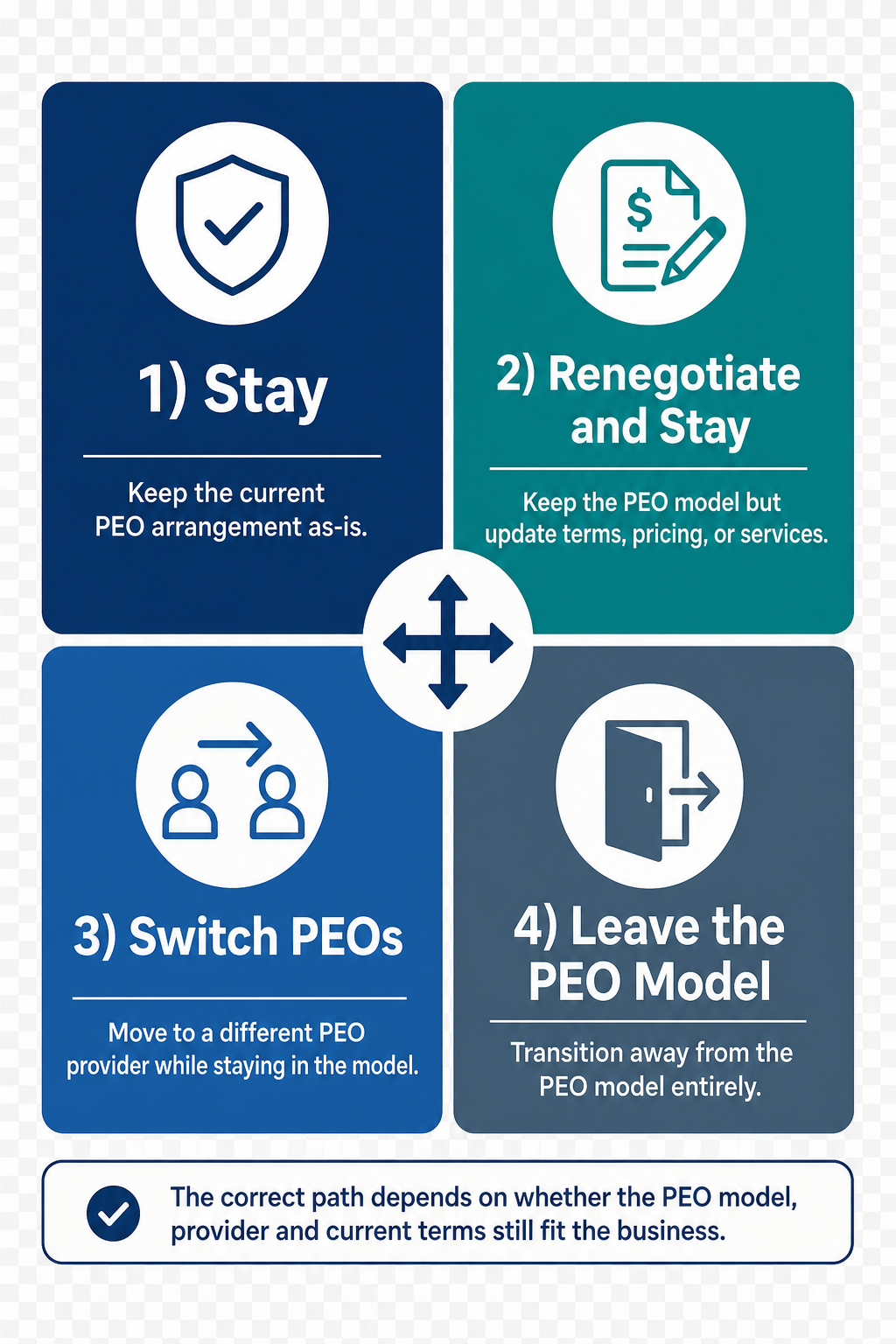
THE SHORT ANSWER - Stay if the PEO model and provider remain aligned. Renegotiate and stay if the relationship works but the terms do not. Switch if the PEO model still fits but the provider does not. Leave if the model itself no longer supports the business. Make the decision from evidence, not the renewal presentation.
Start 120 Days Before the PEO Renewal
Begin the decision process at least 120 days before the renewal date.
Check the agreement first. If its notice deadline falls earlier, that deadline controls. The point of the 120-day rule is to preserve every option before the renewal calendar or contract takes one away.
Starting early gives leadership time to:
- Review the agreement, amendments and notice requirements.
- Audit current costs, benefits and service performance.
- Identify the exact terms or operating conditions that must change.
- Test credible alternatives without turning the process into random quoting.
- Negotiate from evidence instead of urgency.
- Complete underwriting and implementation if a change is required.
Waiting until the renewal arrives shifts leverage to the PEO. Starting 120 days out keeps all four paths available. Review the five critical PEO contract renewal questions before the clock becomes the decision-maker.
Use the Seven-Factor Executive PEO Diagnostic
Rate each factor Strong, Mixed or Weak, then write down the evidence supporting the rating. This is not a mathematical shortcut. It is a way to expose the pattern before a provider's sales presentation starts influencing the answer.
|
Factor
|
Executive question
|
Evidence to review
|
|
Strategic fit
|
Would we choose the PEO model for the company we are now?
|
Workforce, operating model, leadership priorities
|
|
Total economics
|
Is the complete cost explainable and competitive after normalization?
|
Invoices, fees, benefits, workers' comp, taxes, internal labor
|
|
Benefits fit
|
Do plans and employee costs still fit the workforce?
|
Networks, Rx, plan design, contributions, deductions
|
|
Service and fixes
|
Are issues owned, resolved and prevented from recurring?
|
Error log, response times, escalations, outcomes
|
|
Tech and reporting
|
Can leadership obtain the data and integrations it needs?
|
Reporting, data access, integrations, invoice detail
|
|
Risk and execution
|
Is the PEO reliably performing the work assigned to it?
|
Payroll, tax notices, benefits, workers' comp, HR support
|
|
Future readiness
|
Can the relationship support the next 12 to 24 months?
|
Headcount, states, acquisitions, financing, internal capacity
|
Read the pattern this way:
- Mostly Strong: Staying should remain a real option.
- The model is Strong but correctable provider terms are Mixed: Renegotiate and stay.
- The model is Strong but the provider is Weak: Compare replacement PEOs.
- The model itself is Weak: Design and compare a different operating structure before leaving.
NEXT STEP If the ratings are unclear, use the PEO Alignment Score to identify which dimensions deserve a deeper executive review: Take the PEO Alignment Score
The Four PEO Decision Paths
|
Path
|
PEO model
|
Current provider
|
What the evidence supports
|
|
Stay
|
Fits
|
Fits
|
Renew deliberately and document expectations.
|
|
Realign and stay
|
Fits
|
Fits, but terms drifted
|
Correct the terms, then remain with the provider.
|
|
Switch PEOs
|
Fits
|
Does not fit
|
Compare providers on normalized economics and execution.
|
|
Leave the PEO model
|
Does not fit
|
Not controlling
|
Design the replacement operating stack before termination.
|
Path 1: Stay
Staying should be an affirmative decision, not the result of running out of time.
Stay when total costs are explainable and competitive, benefits still fit the workforce, payroll and compliance execution are reliable, service issues are corrected, reporting meets leadership's needs and the provider can support the company's next stage.
A renewal increase does not automatically make the relationship wrong. Benefits, workers' compensation, taxes and other components can change for reasons that are not controlled entirely by the PEO. The question is whether the movement is supported, transparent and consistent with the value being delivered.
EXECUTIVE QUESTION Would we choose this PEO again today under these terms?
If the answer is yes, renew with a documented pricing baseline, service expectations, escalation path and next review date. That is the purpose of Ongoing PEO Advisory.
Path 2: Renegotiate and Stay
Renegotiation is the path to staying when the structure and provider still fit but the terms have drifted.
Administrative pricing may no longer reflect the company's scale. Benefits contributions or plan design may need correction. Workers' compensation classifications may require review. Service responsibilities may be vague. Contract language or notice provisions may no longer fit the business.
The negotiation must be specific. "We need a better deal" is not a position. "The current structure works, but these three terms are no longer aligned with our business or the market" is a position.
EXECUTIVE QUESTION What must change for staying to remain the best decision?
A structured PEO Renewal Optimization should establish the evidence, the requested corrections and the credible alternative before negotiations begin.
Path 3: Switch PEOs
Switch when the PEO model still benefits the company but the current provider can no longer deliver the required outcome.
Repeated service failures, benefits misalignment, inadequate multi-state support, weak reporting, technology limits, poor handling of payroll or tax issues, an underwriting mismatch or uncompetitive pricing can all support a change.
A lower quote is not a better answer. Until every cost, benefit and risk is put on the same page, it is just another sales presentation. Every proposal must be normalized before leadership can determine which option is actually stronger.
EXECUTIVE QUESTION Is the problem the PEO model, or this particular PEO?
Use a disciplined process to compare PEO providers across economics, employee impact, operating capability, contract terms and implementation risk. For the narrower switching signals and transition process, read When to Switch PEOs.
Path 4: Leave the PEO Model
Leaving a PEO is larger than changing providers. It means redesigning who owns payroll, benefits, workers' compensation, HR, compliance and the systems connecting them.
Headcount alone does not answer this question. Operating complexity, workforce risk, internal capability, benefits strategy and the complete cost of the replacement model matter more than an arbitrary employee threshold.
An Administrative Services Organization (ASO) provides outsourced administration without the PEO co-employment structure. Human Resources Outsourcing (HRO) can cover a variable set of outsourced HR functions. A payroll provider processes payroll and related filings but does not, by itself, replace benefits, workers' compensation, and HR infrastructure.
EXECUTIVE QUESTION Are we prepared to own what the PEO currently handles?
A credible PEO Exit Strategy should identify who owns every function on the first day after the transition, not merely name the new vendors.
What This Framework Looks Like in Practice
One published Dinsmore Steele case involved a 42-employee California life sciences company that had remained inside the same legacy PEO structure for more than six years without reevaluation.
We evaluated the alternatives and transitioned the company to a better-fit PEO, replicated key services, added BCBS and Kaiser coverage, replaced percentage-based pricing with a flat per-employee structure and documented $261,581.28 in total savings.
The lesson is not that every longstanding PEO should be replaced. It is that tenure is not evidence of fit. Some reviews support a change. Others validate staying. The review is successful when the decision is defensible.
Verified result: Dinsmore Steele Life Sciences Case Study
Build the Evidence Before Making the Decision
Do not rely only on the PEO's renewal summary. Build your own fact base.
- The current PEO agreement, amendments, renewal notices and termination provisions.
- The renewal package and supporting explanations.
- At least 12 months of representative invoices and administrative-fee detail.
- Benefit plans, employer contributions, employee deductions and renewal changes.
- Workers' compensation classifications, available loss information and audit history.
- Payroll, tax, benefits and service issue records, including open escalations.
- Technology, integration, reporting and data-access requirements.
- Headcount projections, new states, acquisitions, restructurings and capital events.
- The people and systems available to support a switch or a different operating model.
Separate normal market movement from PEO-specific pricing or performance and from changes caused by the company's own workforce, claims, risk or operating profile. Without that distinction, leadership can react to the wrong issue.
A Midyear PEO Change Requires a Separate Control Plan
A midyear change does not have one universal tax, payroll or benefits answer. The outcome depends on the exact payer arrangement, legal entities, plan documents, employee status, states and timing.
Federal employment-tax treatment depends on the actual third-party payer arrangement, not the word PEO. The IRS distinguishes CPEOs, Section 3504 agents, reporting agents and payroll service providers, each with different filing and liability rules. Verify the exact legal entity and EIN involved in the transition.
A midyear move may cause wages to be reported by more than one entity and employees to receive more than one Form W-2, but that result is not automatic. Social Security and FUTA wage-base treatment depends on employer identity and applicable successor rules. CPEOs have special predecessor and successor rules when a CPEO contract starts or ends for a qualifying worksite employee. State unemployment treatment requires a separate review.
A PEO change, by itself, is not automatically a COBRA qualifying event. Before cutover, identify the plan and administrator responsible for existing qualified beneficiaries, notices, premiums and records. Confirm in writing whether a replacement health plan will credit deductible and out-of-pocket accumulators. The Department of Labor's employer COBRA guide explains the underlying notice and continuation requirements.
Before a midyear transition, confirm each of these in writing:
- Medical deductible and out-of-pocket accumulator treatment.
- Carrier networks, formularies, employee elections and effective dates.
- FSA, HSA, retirement-plan and cafeteria-plan handling.
- COBRA and state continuation ownership, notices and records.
- Payroll reconciliation, W-2 reporting and federal wage-base treatment.
- State unemployment wage-base treatment and payroll registrations.
- Workers' compensation policy dates, classifications and audits.
- Data exports, historical records and system access after termination.
| IMPORTANT This material is for general informational and planning purposes only and is not legal, tax, accounting or benefits advice. Results depend on contracts, plan documents, employee status, payer structure, jurisdictions and timing. Confirm the transition with qualified advisers, plan administrators, carriers and payroll providers. |
Avoid the Five Most Common Decision Errors
- Waiting until the renewal is nearly due. Limited time reduces leverage and compresses underwriting, negotiation and implementation.
- Comparing only the administrative fee. The lowest visible fee may not produce the lowest total cost or strongest employee outcome.
- Treating one service failure as a strategy. A serious failure matters, but the decision should reflect the pattern, consequence and provider response.
- Confusing a provider problem with a PEO-model problem. A new provider can solve one. Only a new operating structure can solve the other.
- Accepting a last-minute concession without correcting the structure. A price reduction does not repair weak service, plan design, reporting or contract mechanics.
Put the Recommendation in Writing
The final recommendation should fit on one page and answer six questions:
- What decision are we making?
- Why is it the best available option?
- What evidence supports it?
- What are the financial, operational and employee consequences?
- What risks remain?
- What must happen next, by whom and by when?
Your current PEO should earn the decision to stay. A replacement should earn the decision to switch. Leaving should be supported by a complete operating plan, not simply a desire for more control.
Use the PEO Executive Decision Sheet to put the dates, diagnostic, decision basis, risks, and next action on one page.
Frequently Asked Questions
Should we switch PEOs or renegotiate?
Renegotiate and stay when the PEO model and current provider still fit but correctable terms have drifted. Switch when the PEO model still fits but the provider does not.
Can we renegotiate our PEO agreement without changing providers?
Yes. Define the exact pricing, service, benefits or contractual terms that must change and validate credible alternatives before negotiations begin.
What is the difference between switching PEOs and leaving a PEO?
Switching keeps the company inside a PEO structure with a different provider. Leaving replaces the PEO with a different operating model and reallocates responsibility for payroll, benefits, workers' compensation, HR and compliance.
Can a company change PEOs midyear?
It may be possible. Review contract requirements and confirm benefits, payroll, tax, workers' compensation, COBRA, state registrations and data-transfer responsibilities before moving.
Will employees receive more than one W-2 after a midyear PEO change?
They may, depending on which entities pay and report wages during the year. Confirm the reporting structure with each payer before the transition.
Will employee deductibles transfer to the new health plan?
Not automatically. Ask the replacement carrier and plan administrator to confirm in writing whether deductible and out-of-pocket amounts will be credited.
Is the lowest PEO quote usually the best option?
No. Normalize total cost, benefits value, workers' compensation, taxes, service, technology, contract terms and implementation risk before comparing proposals.
What replaces a PEO after a company leaves?
The replacement may combine an ASO, HRO, payroll provider, direct benefits and workers' compensation arrangements, internal HR capability and outside compliance support. Design the complete stack before termination.
Should we review the PEO even if service is good?
Yes. Good service does not prove that pricing, benefits, contract terms or the overall structure remain aligned. A disciplined review can confirm that staying is still the right decision.
Do Not Let the Renewal Make the Decision
Your company has four possible paths: stay, renegotiate and stay, switch, or leave. The right one depends on whether the current structure still aligns with the business.
Take the PEO Alignment Score to identify how the current relationship performs across governance, pricing and structural alignment, and whether a deeper PEO Alignment Review is warranted.

