PEO
Stay, Renegotiate, Switch or Leave Your PEO?
Use this executive framework to decide whether to stay with, renegotiate, switch or leave your PEO based on cost, service, risk and fit.

Review the PEO client service agreement terms that control fees, renewals, cancellation, services, responsibilities and recourse before you sign.
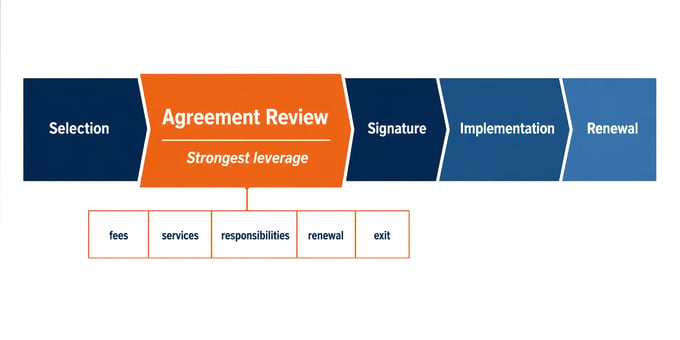
Before signing, make sure the agreement clearly states what you will pay, what the PEO will deliver, how the next renewal will work, who is responsible for each function, what happens when service fails and how you can leave. Everything agreed during the evaluation should be stated clearly in the agreement or an incorporated addendum.
The strongest time to address these terms is after selecting the PEO but before signing. The PEO knows it is close to earning the business, while the company still has meaningful leverage. Changes may remain possible later, but they are usually harder to obtain once the agreement is executed.
Selecting the right PEO is only part of the decision. The company must also secure the right agreement.
A PEO can touch payroll, employment taxes, benefits, workers’ compensation, employee records, HR support and other employment functions. The client continues to operate its business and direct its workforce, but responsibilities are allocated among the company, the PEO and, in some cases, carriers or other vendors.
Those responsibilities vary based on the agreement, applicable law, benefit-plan documents, insurance policies and the service model selected. The client service agreement therefore becomes an operating document, not merely a purchasing form.
Federal tax treatment also requires precision. IRS certification as a Certified Professional Employer Organization affects specified federal employment-tax responsibilities under qualifying CPEO contracts; it is not a blanket endorsement of service quality or a transfer of every employer obligation. The company should verify the exact legal entity on its contract against the IRS CPEO information and public listings.
The PEO proposal comparison may identify the preferred provider, pricing, benefits, technology and service model. The final proposal may also promise dedicated support, recruiting assistance, renewal protection or hands-on HR guidance. Those promises should not remain in a presentation, email or sales conversation.
If a commitment matters to the decision, it should appear in the signed agreement or an incorporated addendum. Otherwise, a clear business expectation can later become a “he said, she said” disagreement among sales, implementation, service and the client.
This is also where many hidden PEO costs begin. The headline price may be accurate, but the agreement can still contain additional charges, fee increases, cancellation exposure or service limitations that were not central to the proposal.
|
Area |
What should be clear |
Why it matters |
|---|---|---|
|
Term and cancellation |
Start date, term, renewal, notice, penalties and permitted exit dates |
Determines when and how the company can leave |
|
Fees and future pricing |
Fee basis, included charges, minimums, increases and headcount tiers |
Establishes the real current and future cost |
|
Benefits renewal |
Timing, negotiated caps or protections and how long they apply |
Affects future economics and predictability |
|
Services |
What is included, discounted or separately billed |
Converts sales promises into defined commitments |
|
Responsibilities |
Who does what, when and with which information |
Prevents gaps, duplication and blame |
|
Service and recourse |
Delivery model, escalation, cure rights, credits and termination remedies |
Establishes what happens when performance falls short |
|
Data and exit |
Records, formats, timing, access and transition assistance |
Protects continuity after termination |
|
Document hierarchy |
Which agreement, schedule or addendum controls |
Prevents conflicting documents from erasing negotiated terms |
The right terms depend on the company’s size, states, workforce, benefits, internal staff and intended use of the PEO. Future caps, fee tiers and included services are negotiated outcomes—not automatic entitlements.
| FREE PRE-SIGNATURE RESOURCE: Download the PEO Agreement Readiness Review |
Cancellation is one of the most consequential and frequently overlooked parts of a PEO agreement.
In Dinsmore Steele’s experience, agreements often require 60 or 90 days’ notice. Some may impose an early-exit charge or a penalty calculated using administration fees and employee headcount when the company terminates before an allowed date or misses the required notice. The exact structure varies by PEO and agreement.
Before signing, the company should know:
A PEO may quote administration as a per-employee-per-month charge, a percentage of payroll or another structure. That number does not necessarily show the full cost.
The agreement and fee schedules should identify minimums, implementation charges, optional-service fees, technology costs, recruiting charges, special payroll work and anything else that may be billed separately. It should also distinguish PEO fees from pass-through items such as benefit premiums, workers’ compensation and statutory taxes.
Growth matters too. A company may be able to negotiate fixed pricing tiers under which its per-employee administration cost declines as headcount rises. If that is part of the deal, the tiers and triggers should be written before signing. Without them, the PEO can gain scale from the added workforce while the client continues paying its original rate.
The objective is not simply a low opening price. It is a cost structure the company can understand, reconcile and forecast.
Companies often negotiate the initial price and leave the first renewal untouched. By the time the renewal arrives, the relationship is operating, employees are enrolled and the cost of changing providers is more visible.
The better approach is to address the next renewal during the initial transaction. Depending on the provider and opportunity, negotiated terms may cover:
These protections are not guaranteed, and their availability varies. But a promise to revisit pricing later is not the same as a negotiated future term.
If the company is already facing an increase, it should also understand its broader options before accepting the renewal. See What to Do After a High PEO Renewal.
The agreement and addenda should identify every service the company expects to receive and whether it is included, discounted or separately billed.
That may include payroll support, benefits administration, enrollment, COBRA, HSA/FSA/HRA support, claims support and escalation, workers’ compensation administration, HR guidance, employee relations, recruiting, compliance resources, training, reporting, integrations, implementation and employee support.
The agreement should also reflect the selected service model, including any agreed team, resources, escalation channels or support commitments.
The agreement should make clear who does what, who is responsible for the outcome, when each party must act and what information each party must provide.
That applies to payroll inputs, wage payments, employment-tax reporting, benefit eligibility, enrollment, COBRA, HSA/FSA/HRA administration, claims support, workers’ compensation reporting, employee notices, HR guidance, recordkeeping and other agreed functions.
The allocation is not identical across PEOs. It can also be affected by law, plan documents, insurance contracts and separate addenda. A company should not assume the PEO owns a responsibility merely because the proposal uses a broad phrase such as “full-service HR.”
Clear responsibility protects both sides. It prevents a problem from reaching the employee before the company and PEO discover that each believed the other was handling it.
“Excellent service” is a sales description, not an operating standard.
The company should understand whether support is dedicated, team-based or routed through a service center; how payroll, benefits and HR requests are handled; who supports employees; and how urgent matters escalate. Where specific commitments are agreed, they should be included in the final documents.
The agreement should also address recourse. Depending on what is negotiated, that may include an escalation process, a period to correct the issue, service credits, fee adjustments, transition assistance or a right to terminate after an uncured material failure.
Even a well-chosen PEO can have service problems. Dinsmore Steele’s AfterCare and ongoing PEO advisory helps companies monitor renewals, billing and service after implementation, but the written agreement should still establish the foundation.
Termination affects far more than the final invoice. The company may need payroll history, employee records, tax reports, benefit information, claims data, workers’ compensation records, system exports and help transitioning to another platform.
The agreement should define what the PEO will provide, in what format, on what schedule and at what cost. It should also address system access after termination, support for open matters and responsibility for filings or claims that extend beyond the termination date.
The company should not discover during a transition that essential records are delayed, inaccessible or subject to an unexpected fee. If leaving the PEO model may become necessary as the business grows, review the PEO exit strategy before the exit is urgent.
A PEO transaction may include the primary agreement, pricing schedules, benefit-plan documents, workers’ compensation addenda, technology terms, implementation documents and negotiated amendments.
Those documents must work together. The company should know which document controls if two provisions conflict and whether the final agreement incorporates the proposal or excludes prior representations.
A concession contained only in an email may not carry the same force as a term incorporated into the signed agreement. The commercial review and legal review should therefore cover the entire package, not one document in isolation.
The ideal review occurs after the company selects its preferred PEO but before it signs.
At that stage, the company understands the proposed benefits, technology, pricing and service model. The PEO knows it is close to winning the business. The agreement is still open, and the company has its strongest opportunity to align the written terms with the decision it intends to make.
After signature, changes can still occur through amendments or later renewal negotiations. The difference is leverage: the company has already awarded the business, implementation may be underway and switching becomes more disruptive.
That is why administration pricing, future fee tiers, renewal protections, included services, cancellation, responsibilities, recourse and exit support should all be addressed before the agreement closes.
Dinsmore Steele recently advised a 189-employee company after it had selected its preferred PEO but before it signed the client service agreement.
The PEO remained the same. The employee census and service scope remained the same. Dinsmore Steele reviewed the administration, benefits, services, renewal structure and related commercial terms.
Compared with the selected PEO’s original proposal, the completed negotiation produced $82,000 in annual service and administrative-fee savings. The company also secured improved benefit and service terms.
The result did not come from moving to a stripped-down solution. It came from ensuring that the selected solution was priced and documented correctly before the company committed.
This anonymized result is specific to one client and is not typical or guaranteed. Outcomes vary by employer, provider, workforce, risk, services, market conditions and available terms.
A PEO is a specialized product combining benefits, payroll, HR, workers’ compensation, employment taxes, technology and service delivery. A benefits broker may understand medical coverage. A property and casualty broker may understand workers’ compensation. Those specialties alone do not necessarily address the complete PEO structure.
Companies often do not know what is standard, what is missing, what can be negotiated or which questions should be asked. A strategic PEO advisor evaluates the commercial and operational structure. Qualified legal counsel evaluates legal language and consequences. Both should confirm that everything agreed is clearly and cleanly stated.
A PEO Alignment Review connects the agreement to the entire business decision: price, benefits, service, technology, responsibilities, renewal exposure and structural fit.
It is the contract governing the relationship between a company and its professional employer organization. It generally addresses fees, services, allocated responsibilities, term, renewal, termination and related operating requirements.
No. That depends on the contract and incorporated documents. Material proposal terms and sales commitments should appear in the signed agreement or an incorporated addendum.
Yes, but outcomes vary by PEO, company size, risk profile, services and market conditions. Potential areas include fees, future tiers, services, renewals and cancellation. None is an automatic entitlement.
After selecting the preferred PEO and before signing. This is generally the company’s strongest point of leverage and the cleanest time to correct inconsistencies.
In Dinsmore Steele’s experience, both appear frequently, but terms vary. The company must review its own agreement for the exact deadline, termination date, delivery method and consequences.
Some agreements do. Dinsmore Steele has seen charges tied to administration fees, headcount, a missed notice period or the remaining term. The signed agreement controls.
Sometimes. A PEO may agree to future administration pricing, benefit-renewal protections, service terms or headcount tiers. Availability and duration depend on the transaction and must be documented.
No. IRS certification has defined federal employment-tax effects under qualifying contracts. Other responsibilities depend on the agreement, applicable law, benefit-plan documents and insurance arrangements.
Company leadership, a strategic PEO advisor and qualified legal counsel should review the complete agreement package from their respective commercial, operational and legal perspectives.
The company should preserve the final documents, confirm implementation matches the agreement and monitor billing, service and renewals. Agreement review is the beginning of governance, not the end.
Do not sign merely because the proposal looks attractive.
The agreement should reflect the complete decision: what the company will pay, what it will receive, how the next renewal will work, who is responsible, what recourse exists and how the relationship can end.
There may be better terms available, but the company has to identify and explore them before signing. Dinsmore Steele’s PEO Alignment Review examines the entire relationship without turning the process into a do-it-yourself contract exercise.

| ABOUT THE AUTHOR |
| Rodney Steele is the founder and CEO of Dinsmore Steele. He has spent 16 years advising companies on PEO selection, renewal, transition, and governance. Dinsmore Steele has completed more than 6,100 PEO engagements since 2010. |
Use this executive framework to decide whether to stay with, renegotiate, switch or leave your PEO based on cost, service, risk and fit.
Learn how PE operating partners audit PEO pricing, negotiate contract renewals, and protect portfolio margins with independent benchmarking.
Learn how to document and escalate recurring PEO payroll, benefits and service problems while protecting employees and holding your provider ...