The company you bought has added a second location, acquired a business and hired an HR leader. The payroll and benefits arrangement still reflects the workforce you inherited at close. At the next portfolio review, someone reports that the renewal came in within budget. That answers the budget question. The operating partner still needs to know whether the arrangement works for the company they own today.
Start with two decisions. For a portfolio company that uses a professional employer organization (PEO), independently test whether the incumbent still fits the workforce, cost structure and growth plan. For a company that operates outside a PEO, identify the problem first and then decide whether the model deserves a comparison. Use the same initial questions across the portfolio and follow the facts at each company.
Why longer holds change the review
McKinsey estimates that 52 percent of global buyout-backed inventory had been held for more than four years as of 2025, the highest share in its analysis. The same report says global private equity exit value rose more than 40 percent that year. More value changed hands while a large share of companies remained in the portfolio. McKinsey Global Private Markets Report 2026
The operating implication is straightforward. A benefits decision made at close may have to serve the business through several more renewals, new states or acquisitions. Any unresolved cost, coverage or administrative problem can affect more employees and more payroll cycles. The same extra time can also make it worthwhile to improve an incumbent arrangement that still serves the business well.
Use the parts of your operating plan that are already concrete. If the next add-on will bring a workforce in another state, find out whether the existing health network works there. If the business now employs a head of HR, check which work the company still buys from its provider and which work the new team performs. Those are specific questions that can change a decision.
Select two or three companies for a closer look
Ask each portfolio company for the current model, the provider or providers, the internal owner, the next renewal, the notice deadline and the date and scope of the last independent review. Add what has changed since the arrangement was selected. Examples include new states, an acquisition, a change in employee contributions, a larger HR team or a persistent payroll or enrollment issue.
Record a reason for selecting each company. A company opening in a new state in May has a decision date tied to hiring and enrollment. A company facing an unexplained increase needs to reconcile the new proposal to actual enrollment and costs. A company with recurring service failures may need an escalation owner and service correction before it needs a market comparison. An older agreement can remain appropriate when the operating requirements and economics still fit.
Start with company-level information. Approximate headcount, operating states, a summary of current services and upcoming decisions are enough to prioritize the work. Request detailed invoices, plan documents or employee information when the purpose is clear and the right people are involved. A useful first pass gives the operating partner an ordered list with one question to answer at each company.
Does the incumbent PEO still fit?
Ask what the company actually reviewed the last time it renewed. Many renewal discussions start with the proposed rate change and a budget decision. An independent benchmark starts with the business requirements, the existing agreement and actual costs. It then compares the incumbent with credible options that can support those requirements.
An annual review can be brief. Have finance reconcile costs, have HR record material employee or service issues, and ask management whether its next milestone changes the scope the provider needs to support. A deeper comparison is warranted when a change could affect the recommendation. An acquisition, a new state, a major renewal increase that finance cannot explain or recurring service failures are all reasonable triggers.
Build the comparison from what the company pays
Start with the invoice and payroll records. Identify administrative charges, employer benefits costs, payroll deductions and other applicable charges. Show adjustments, credits, minimum charges and separately billed services. For each number, note the period it covers and whether the amount is recurring, temporary or still being verified.
Then bring the proposals onto the same terms. Use the same employee census, enrollment assumptions, coverage period and scope of service wherever possible. Show first-year credits and implementation fees separately from recurring charges. Review the contract terms behind a projected renewal, including what is fixed, what can reset and which assumptions could change the cost. A proposal can move to the top of a spreadsheet when an introductory credit is carried into later years.
Give employees their own line of analysis. Compare payroll deductions by coverage tier, deductibles, out-of-pocket exposure and access to care where employees live and work. Report what changes for the employer and for employees. If the employer saves because employees pay more, leadership should be able to see the transfer and decide whether it is acceptable.
For a multistate company, check whether the plan comparison reflects where people are actually enrolled. A favorable network comparison near headquarters may miss a region where the company has just added employees. Ask HR which locations and coverage tiers are most affected, then verify those differences before using a single portfolio-wide assumption.
Ask HR what it takes to make the arrangement run. Can someone get an enrollment error corrected promptly? Does finance have enough detail to reconcile billing without recurring manual work? Can payroll and HR get the records they need for the next acquisition? Gaps here affect implementation capacity and service even when the contracted fee looks competitive.
Test the decision beyond year one
Model a plausible downside alongside the base case. If enrollment grows faster than expected, show which charges change. If a hiring milestone slips, identify which fees still apply. If an acquisition closes ahead of schedule, establish which employees and entities the proposed arrangement can accommodate and what the team would need to do.
Validate notice deadlines, the responsibilities at termination and access to payroll and benefits records with the appropriate advisers. Then add the work of changing providers. Data conversion, payroll testing, integrations, employee communication and management time can materially affect the economics and timing. Ask for the full decision and implementation plan before committing to a change: Dinsmore Steele PEO exit strategy
Consider a hypothetical portfolio company that acquires an operation in a second state. Finance receives a manageable renewal. HR learns that some employees in the acquired operation would lose access to providers they use if the plans were harmonized immediately. The company has also hired an HR lead who can assume parts of the administration. Ask the incumbent for a workable network and a revised service scope, then compare the terms with alternatives. The company may keep its PEO and renegotiate, change providers or continue the current plan for a defined period while it prepares a transition. The decision comes from coverage, capacity and timing as well as price.
Would a PEO solve an operating problem?
For a company outside a PEO, describe the problem in terms the operating team can test. Perhaps payroll and benefits are administered across several systems, and HR has to reconcile changes manually. An acquisitive business may have inherited different contribution rules and vendors. A small HR team may be spending so much time coordinating routine work that it lacks capacity for hiring or employee relations.
Write down the specific work that needs to change. Identify what the internal team does well, where it wants outside help and which decisions it wants to own. Ask which existing relationships, software integrations or plan features would have to remain in place. Include employee locations, benefits needs, workforce size and expected growth. A structure that works for one company can be inappropriate for a company in the same portfolio with different staffing and service needs.
Build a baseline using the current benefits, technology, payroll and administrative costs. Include the work handled internally and the issues the team has to resolve. Then compare improving the current arrangement with an administrative services organization (ASO) or a PEO where those models can meet the requirements. Confirm the proposed services and responsibilities in writing. The provider category gives you a starting point and the actual agreement determines what is included.
For example, if the benefits arrangement works well and the real problem is payroll integration, compare a targeted integration fix with a broader change in model. A PEO could be useful if the business needs a broader set of services and the financial and operating terms hold up. If the problem is concentrated in one vendor handoff, the company may get the result it needs by fixing the handoff.
Examine which benefits relationships can stay
Some portfolio companies have a benefits broker they trust or a health plan they want to retain. Work through those as distinct requirements. Ask whether the provider arrangement permits the current broker to remain, and separately whether the company can keep the existing medical plan. Confirm who administers enrollment and eligibility, who handles employee questions and who is paid for which part of the work.
Write down responsibilities when two vendors touch the same issue. If an employee’s coverage record is incorrect, determine who corrects it, who confirms the correction and who communicates with the employee. If the benefits broker and payroll or HR provider can work together, the arrangement should name the handoffs. If the company has to manage all of them itself, include that workload in the comparison.
Work backward from the business date
A renewal date is one milestone. New-state hiring, an acquisition close or a planned change to the company’s HR systems may create an earlier decision. Find the actual notice deadline and any effective dates that matter. Work backward through the time required to gather evidence, review alternatives, secure approvals, communicate with employees and complete a tested implementation.
Have the people responsible for the work validate the plan. Finance can confirm payroll and billing checks. HR can verify employee communications and enrollment. The provider can explain its deadlines, dependencies and responsibilities. A decision date belongs on the calendar with a specific owner whose team can act on it.
If an urgent problem arrives before there is time for a considered transition, protect the immediate milestone first. For a new location that could mean confirming current coverage and starting an interim enrollment process. For an acquisition, it could mean preserving separate arrangements until payroll and eligibility are ready. Record when leadership will revisit the larger decision and what evidence it needs by that date.
Put the initial question into diligence
When a target already uses a PEO, ask for the current agreement, a recent invoice and a summary of the covered entities and workforce. Establish which parts of the arrangement the deal team is assuming will carry through close. Have the company and its advisers confirm what the agreement and the provider actually allow, what the first payroll and benefits cycle will require and whether anything must be resolved before close.
Answer three questions in the deal memo. What has to work on Day 1? What should go into the operating model for the first year? Which decisions can the operating team safely make after it owns the business? A near-term renewal can affect the forecast even when the company intends to retain its provider at close. A future integration can create a second decision if the sponsor wants the acquired workforce to move into a platform company’s arrangement.
Keep the diligence recommendation proportionate. If continuity is workable and the diligence team can explain the costs, ownership can start with a defined post-close review date. If a required decision falls before close, put the dependency in the transition plan with an accountable owner. The deal team can make its financial and integration assumptions explicit while the operating team has enough time to test the longer-term fit: Dinsmore Steele PEO advisory for private equity
Make a decision and check what happened
At the portfolio review, ask the responsible executive for a one-page recommendation. It should say what changed in the business, what the team found in the evidence, what alternatives it considered, what employees would experience, and who owns the next action. Add the notice deadline, the decision date and the specific fact that would change the recommendation.
For an incumbent, the answer can be to keep the arrangement, renegotiate terms, change providers or move to another model. For a company outside a PEO, it can be to keep or improve its structure, add administrative support or adopt a PEO. If an outside option solves one problem and reintroduces a harder one elsewhere, document the tradeoff in plain language. An operating partner needs to be able to explain why the company chose its path six months later.
Different companies in the same fund can reach different answers using the same review. Set a common standard for the evidence and the decision record. Require a comparable cost baseline, a documented workforce impact and a named owner. Let the company’s needs determine the arrangement. Across the portfolio, use those records to see where common problems recur. Three companies struggling to obtain usable billing detail may merit a shared reporting requirement even if they keep different providers.
Use a small set of measures tied to the original problem. If the goal was cost visibility, finance should be able to reconcile the first complete invoice and payroll cycle to the approved case. If the issue was access to care, HR should verify the affected locations, explain any changes to employees and identify coverage issues that remain open. If the goal was to free up HR capacity, check whether the tasks transferred as agreed. If management chose to retain its provider and seek a service correction, verify that the recurring issue actually stopped.
Treat exceptions as operating work. When an employee deduction is wrong, record the owner, the correction date and how the employee will be informed. When actual fees differ from the proposal, establish whether enrollment, scope or billing caused the difference. Schedule a later check after enough operating experience exists to assess the result. A signed agreement starts this work and the completed checks tell you where the decision held up.
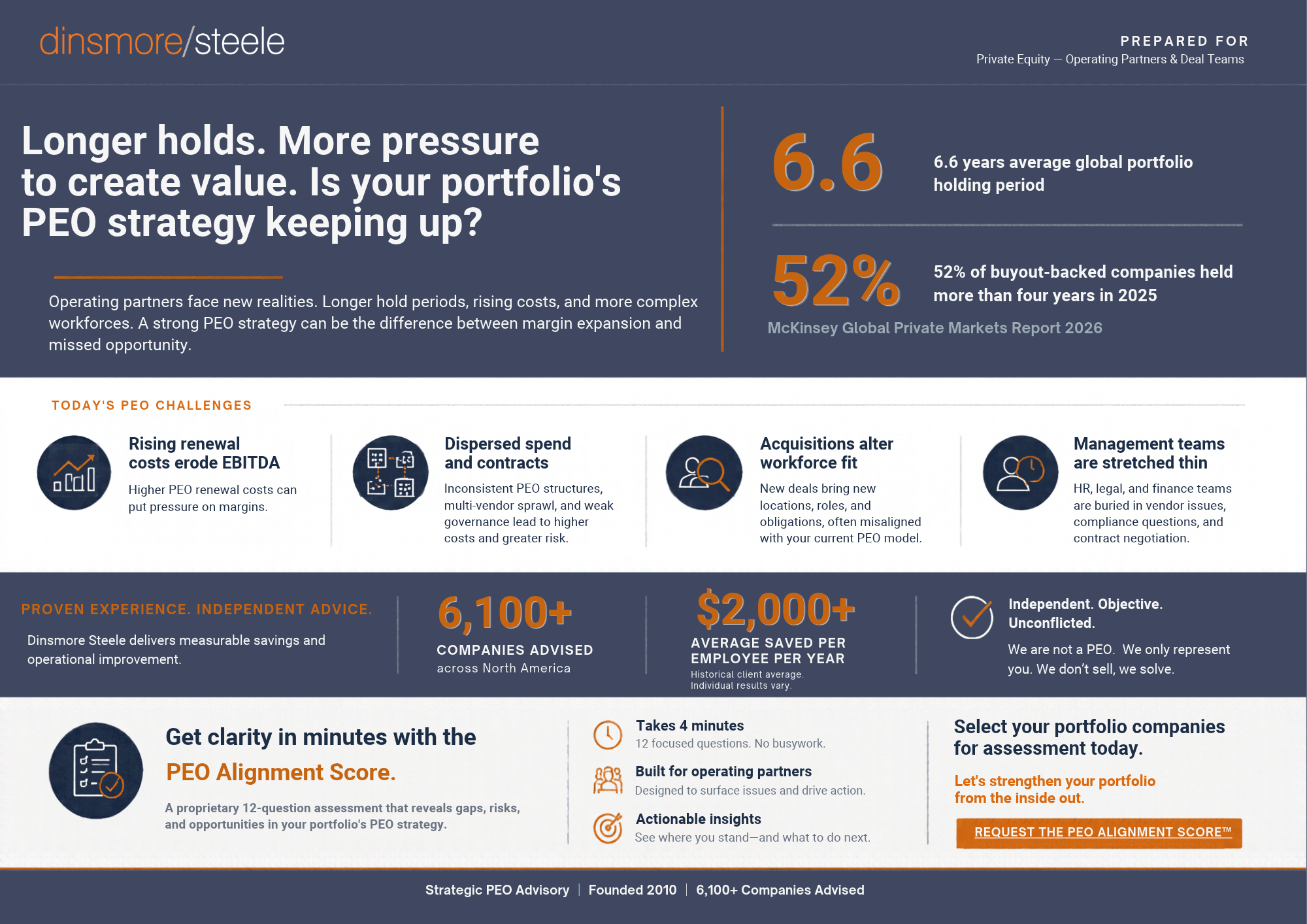 Download the one-pager (PDF)
Bring the right questions to your next portfolio review
Ask the portfolio team to bring two or three companies where something specific has changed. For each company, have finance state the cost issue, have HR state the workforce or service issue and have management state the next milestone. Identify who can make the decision and when they need the evidence. That gives the meeting an outcome even if the answer is to keep the current arrangement.
If you need a first pass across selected companies, the PEO Alignment Score™ takes about four minutes per company. It uses separate questions for companies that already use a PEO and those considering one. Ask each company to complete it using its own circumstances, then use the responses to decide where to reconcile costs, validate benefits fit or compare operating models in more depth.
Start the PEO Alignment Score for your portfolio companies